
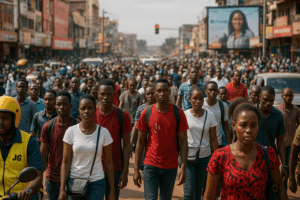
UgandaToday: Ticking Demographic Time 💥 Boom In East Africa — Competence Is The New Law Or Death Awaits Regimes

Director of Strategy and Innovation, Ideation Able Holding Ltd (Uganda)
Social Entrepreneurship Consultant
📧 Email: davidkafeero2@gmail.com
By Kafeero David | Uganda Today | davidkafeero2@gmail.com
Uganda at the Crossroads of a Regional Awakening
Uganda’s political and economic trajectory is showing cracks under the weight of its own contradictions. Once viewed as a model of recovery and stability, the country has instead become a testing ground for radical neoliberalism — a playground where foreign corporations thrive while local industry suffocates under punitive taxes and extortionate bank interest rates.
Sectors like banking, telecommunications, and agro-business remain dominated by multinational corporations protected by generous tax exemptions, while indigenous entrepreneurs are left to battle financial exclusion. Despite GDP growth narratives, poverty and inequality remain endemic, underscoring a grim truth — Uganda’s economy benefits elites more than its citizens.
A Constricted Political Space
Political participation in Uganda has become an orchestrated performance, not a democratic process. Elections are frequently marred by state violence, biased media, intimidation, and internet shutdowns, reducing them to rituals of control rather than expressions of citizen will.
President Yoweri Museveni’s 40-year rule has entrenched a system that criminalizes dissent and glorifies loyalty over merit. Security forces, rather than protecting the people, often act as enforcers of political order, silencing potential reformers and intellectuals alike. This shrinking civic space has left little room for innovation or constructive political competition.

The Squandered Demographic Boom
With over 70% of its population under 30, Uganda is sitting on what should be a demographic goldmine — yet it risks turning into a ticking time bomb.
The youth, educated yet unemployed, are being courted for political mobilization rather than economic transformation. Their frustration is rising as their potential remains untapped, turning what could be a demographic dividend into a demographic threat. Without visionary leadership, Uganda’s youthful population could become a source of instability instead of innovation.
Regional Contrasts: The East African Mirror
According to the Chandler Good Governance Index (2024), Uganda’s stagnation becomes clearer when viewed alongside its neighbors.
| Country | Overall Ranking (out of 113) | Key Strengths | Key Weaknesses |
|---|---|---|---|
| Uganda | 91st | Financial Stewardship (46th) | Strong Institutions (92nd), Helping People Rise (93rd) |
| Tanzania | 80th | Leadership & Foresight (57th) | Weak Laws & Policies |
| Kenya | 91st (tie) | Public Banking, Infrastructure | Governance Weaknesses |
| Rwanda | 56th | Institutional Quality | Limited Data |
While Uganda struggles with governance inertia, Tanzania and Kenya are building functional public institutions, public banks, and inclusive economic systems that empower citizens. The regional lesson is clear: competence, not charisma, defines the future of governance.
A Way Forward: Reclaiming the Republic
Uganda’s renewal must begin with radical honesty and strategic reform of its political economy.
1️⃣ Re-evaluate Economic Allegiances
Uganda must end the auctioning of national assets to foreign corporations and nurture homegrown industries. Fair taxation, affordable credit, and reinvestment in transport, education, and healthcare should anchor national productivity.
2️⃣ Open Political and Civic Space
Genuine multi-party democracy is essential. Political competition, freedom of expression, and institutional independence are prerequisites for a stable state. The militarization of politics must end.
3️⃣ Invest in People, Not Patronage
Uganda’s 14 civilizations and diverse cultures are reservoirs of knowledge and resilience. Harnessing this richness through technical training, innovation, and value-chain entrepreneurship could unlock massive growth.
Governance should reward competence, not loyalty — a merit-based system that inspires citizens and holds leaders accountable.
Final Reflection: From Performance to Productivity
Uganda’s fate hinges on its ability to shift from performative politics to productive governance. The survival of the current system depends on whether it can reinvent itself around truth, capacity, and merit.
In the face of East Africa’s demographic awakening, competence has become the new law — and regimes that ignore it risk political extinction.
#UgandaToday #PhoenixNewsFeeds #OperaNewsFeeds
#EastAfricaRising #UgandaEconomy #YouthUnemployment #GovernanceCrisis #CompetenceRevolution #DavidKafeero
Publisher