UgandaToday: The Man Without a Portrait: Museveni’s 40-Year Grip on Power and the Mystery of the Missing Image on Uganda’s Currency
By UgandaToday Political Desk
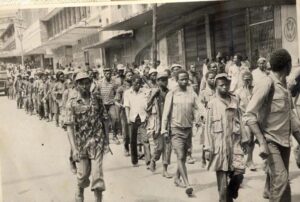
For nearly four decades, Yoweri Kaguta Museveni has dominated Uganda’s political landscape with a resilience rarely seen in modern African politics. From a bush war revolutionary who promised democratic renewal to one of the continent’s longest-serving leaders, Museveni’s tenure has stretched from 1986 towards the half-century mark.
Yet amid the longevity, a curious symbolic absence lingers: Museveni’s portrait has never appeared on Uganda’s currency notes.
Across Africa and beyond, long-serving rulers often immortalize themselves on banknotes and coins as a marker of political permanence. But Uganda’s currency continues to feature national landmarks, wildlife, and historical figures instead.
The question that increasingly surfaces in political discourse is simple but profound: Is the absence of Museveni’s portrait on the shilling a deliberate political strategy—or the subtle acknowledgment of an unfinished legacy?

The Revolutionary Who Promised to End Life Presidencies
When Museveni’s National Resistance Army marched into Kampala in January 1986 after a five-year guerrilla war, he famously declared that “the problem of Africa is leaders who overstay in power.”
Four decades later, the irony of that statement has become a central theme in Uganda’s political debate.
Museveni’s rise initially inspired hope in a country emerging from the brutal eras of Idi Amin and Milton Obote. The early years of the National Resistance Movement government brought relative stability and economic reforms that won international praise.
But over time, critics say the political architecture built after the 1995 Constitution has been steadily reshaped to accommodate Museveni’s continued rule.
Constitutional Engineering: Removing Term and Age Limits
One of the most defining features of Museveni’s longevity has been constitutional amendments that progressively removed barriers to indefinite rule.
In 2005, Uganda’s Parliament amended the Constitution to remove presidential term limits, allowing Museveni to run for additional terms beyond the original two-term cap.
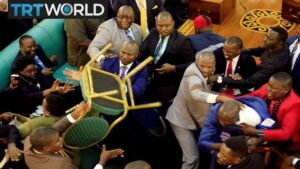
More than a decade later, another controversial amendment erased the presidential age limit of 75 years, clearing the path for Museveni to contest elections indefinitely.
The amendment was passed amid chaotic scenes in Parliament, including physical confrontations between legislators, reflecting the intensity of the national debate.
Critics argue these changes effectively dismantled the safeguards designed to prevent the emergence of a life presidency.
Ignoring Electoral Reform Demands
Another recurring controversy involves the failure to implement comprehensive electoral reforms recommended by the judiciary.
Following contested elections, Uganda’s Supreme Court has repeatedly pointed to irregularities and urged the government to enact reforms to ensure free and fair elections.
Opposition leaders and civil society groups argue that the government has largely ignored those recommendations, allowing structural issues in Uganda’s electoral system to persist.
The Security State: Police, Military and Political Power
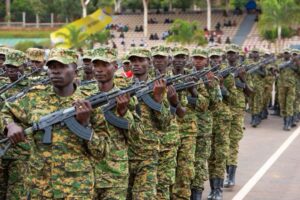
Observers frequently cite Museveni’s firm grip over Uganda’s security architecture as a pillar of his political survival.
The Uganda Police Force and the Uganda People’s Defence Forces (UPDF) have played prominent roles in political processes, particularly during election cycles.
Critics accuse the state of deploying security agencies to manage opposition activities, break up rallies, and maintain political control.
International reports have repeatedly noted allegations of detentions of opposition supporters and heavy security deployment during campaigns, accusations the government routinely denies.
Museveni himself has long defended the strong role of the military, arguing that Uganda’s turbulent past requires a firm security foundation.
Military Influence in Civilian Governance
Another feature of the Museveni era has been the extensive appointment of serving or retired military officers to civilian government roles.
From district administration to cabinet positions and strategic state agencies, former military commanders occupy influential roles across the political system.
Supporters say this reflects the National Resistance Movement’s revolutionary roots. Critics say it blurs the line between military authority and civilian governance, weakening democratic institutions.
Judiciary Orders and Political Tension
The relationship between the executive and judiciary has also been strained.
Several court rulings—such as judgments questioning the trial of civilians in military courts—have triggered intense political debate.
Human rights organizations argue that the continued prosecution of civilians in military tribunals contradicts constitutional principles, while government officials insist such courts are necessary for national security.
The Muhoozi Factor
Perhaps the most intriguing political subplot in recent years involves Museveni’s son, Muhoozi Kainerugaba.
The senior military officer and army commander of Uganda forces has repeatedly drawn headlines for controversial statements on social media and political commentary—actions critics say contradict the code of conduct expected of a serving officer.
Despite the controversies, Muhoozi has rarely faced visible disciplinary action, fueling speculation about succession dynamics within the ruling establishment.
Elections Without Transition
Uganda has held regular elections since 1996, but the presidency has never changed hands through the ballot box.
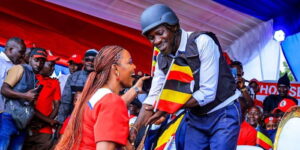
Opposition figures such as Kizza Besigye and Robert Kyagulanyi Ssentamu—popularly known as Bobi Wine—have repeatedly challenged Museveni’s dominance.
But Museveni has continued to win elections, extending his rule toward a possible five decades in power if future terms are secured.
Supporters credit him with maintaining stability, economic growth, and regional security influence. Critics accuse his administration of suppressing dissent and entrenching authoritarian governance.
The Symbolism of the Missing Portrait
Against this political backdrop, the absence of Museveni’s portrait on Uganda’s currency notes becomes symbolically intriguing.
Many long-serving leaders—from monarchs to presidents—use national currency to immortalize their image as a representation of authority and permanence. Museveni has never taken that step.

Some interpret this as political modesty. Others see it as a calculated effort to avoid the symbolism of personality cults often associated with entrenched regimes. But another possibility lingers.
Perhaps the portrait has not appeared because the story of Museveni’s rule is not yet complete.
Forty Years Later: The Unfinished Question
As Uganda approaches the 40-year mark of Museveni’s presidency, the question confronting the country is no longer simply about longevity.
It is about the future of political transition.
Will Uganda eventually witness a peaceful handover of power through democratic institutions? Or will Museveni’s era continue to stretch further into history?
For now, the banknotes in Ugandans’ pockets carry images of cranes, monuments, and landscapes—but not the face of the man who has governed the country for nearly half a century. And perhaps that absence speaks louder than any portrait ever could.
Hashtags:
#UgandaToday #PhoenixNewsFeeds #OperaNewsFeeds #UgandaPolitics #Museveni40Years #GovernanceDebate
Publisher