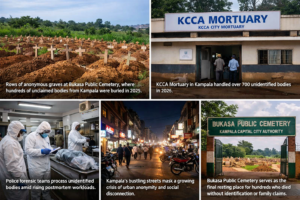
KCCA Mortuary in Kampala handled over 700 unidentified bodies in 2025, highlighting a growing urban humanitarian crisis.
Police forensic teams process unidentified bodies amid rising postmortem workloads across the country.
Kampala’s bustling streets mask a growing crisis of urban anonymity and social disconnection.
Bukasa Public Cemetery serves as the final resting place for hundreds who died without identification or family claims.
UgandaToday: Police Alarm Over 509 Unclaimed Bodies Buried in Kampala Public Cemetery
Kampala, Uganda — A sobering police annual health report has revealed a silent humanitarian crisis unfolding in the heart of Uganda’s capital: 509 people died in Kampala in 2025 and were buried without anyone coming forward to claim their remains.
No names.
No relatives.
No closure.
The unclaimed bodies were processed through KCCA Mortuary and laid to rest at Bukasa Public Cemetery, anonymously. In a city renowned for its relentless pace and dense population, more than five hundred lives ended without a single public acknowledgment that “this one was ours.”
According to the report, KCCA Mortuary handled 723 unidentified bodies during the year under review. Only 214 were eventually identified and claimed. The remaining nearly 70 percent were buried as unknown persons—reduced to numbers in an annual report and markers in public graves.
Behind each “unknown body” was a human being who once worked, prayed, laughed, struggled, and belonged somewhere—until they didn’t.

A Social Crisis, Not Just a Forensic One
While the statistics reflect a heavy forensic workload, they also expose a deeper societal breakdown that has become dangerously normalised. Urban anonymity, poverty, mental illness, migration, family disintegration, and weakened community safety nets are converging at the mortuary slab. When death arrives, it increasingly finds people who were already abandoned in life.
The scale of forensic activity underscores a system straining to manage consequences rather than causes. More than 4,600 postmortems were conducted at KCCA Mortuary in 2025 alone. These were supplemented by DNA analysis, toxicology tests, ballistics examinations, fingerprinting, and even 3D forensic photography. Across the country, police surgeons carried out over 1,200 postmortems and multiple exhumations.
It is a technically sophisticated response to death—but one addressing a profoundly human failure as a procedural task.
Disturbing Patterns in Death
The report reveals unsettling trends. February recorded the highest number of unidentified bodies, while December—traditionally a season of family gatherings and celebration—registered the highest number of unclaimed burials.
The contrast is jarring. As some families reunited to celebrate life, others never even knew their loved one had died—or knew but lacked the means to respond. In some cases, poverty and distance proved insurmountable. In others, fractured family ties meant no one was left to ask questions.
A Question the Nation Must Face
The data forces an uncomfortable national reckoning:
How did Uganda become a society where hundreds can disappear and die without anyone noticing in time—or caring enough to claim them in death?
Had these deaths resulted from a single catastrophe, the country would have observed national mourning, political speeches, and public accountability. Instead, because they occur quietly—on streets, in slums, in lodges, in isolation—the crisis remains invisible. Statistics replace stories. Reports replace responsibility.
The Way Forward
Experts argue that Uganda urgently needs stronger systems for tracing next of kin, improved coordination between police, hospitals, local councils, religious institutions, and community leaders, and public awareness mechanisms to help families identify missing relatives early.
Traditional community structures that once ensured no one died alone are collapsing under urban pressure. The state, meanwhile, has yet to adequately fill the gap.
The 509 unclaimed bodies buried at Bukasa Public Cemetery are more than evidence of death. They are evidence of neglect—social, institutional, and moral. Until these deaths are treated as a collective failure rather than an administrative burden, the mortuary will continue doing what society has failed to do: keep the final record of people we chose not to see.
#UgandaToday #PhoenixNewsFeeds #OperaNewsFeeds #Kampala #PublicHealth #SocialCrisis
Publisher