Uganda Today: Museveni Praises Obote’s 1966 Invasion Of Mengo Palace As A Resolution For Buganda
By Uganda Today Political Desk | www.ugandatoday.co.ug
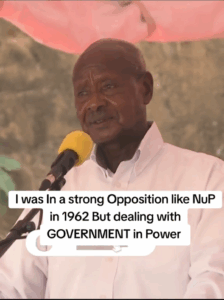
President Yoweri Kaguta Museveni has stirred political and historical controversy after openly praising the 1966 military invasion of the Lubiri (Kabaka’s palace) in Mengo by then-Prime Minister Apollo Milton Obote. In a widely circulating TikTok video, Museveni, speaking in Luganda, described the act not as a brutal attack but as a “peaceful” and “proper alignment” of Buganda.
The president’s remarks, captured from what appears to be a casual interaction with a gathering of youth or supporters, have reignited decades-old tensions surrounding one of Uganda’s darkest political chapters — the infamous 1966 crisis that saw the palace of Kabaka Edward Muteesa II surrounded by troops under the command of Idi Amin and eventually set ablaze, forcing the Kabaka into exile in London, where he later died.
Museveni Recalls HIS DP Roots Under Obote Government
In the video, Museveni shares what he frames as a personal historical recollection. He narrates that in 1962, he was a young member of the Democratic Party (DP), the opposition at the time, while Apollo Milton Obote led the government. Museveni explains that Obote, in a political maneuver, allied with the Buganda Kingdom through the Kabaka Yekka (KY) party in order to defeat DP’s leader Benedict Kiwanuka in the post-independence elections.
“Obote plotted with Mengo to dislodge Benedict Kiwanuka,” Museveni said in the video. “He used Kabaka Yekka to defeat DP. But later, Obote turned around and fought the very people he had used — the Baganda.”

According to Museveni, this culminated in Obote sending then-Colonel Idi Amin to storm the Lubiri in 1966 — an operation that burned the royal palace and expelled Kabaka Muteesa from his ancestral seat.
“Alignment (Okutereeza) Not Destruction” — Museveni’s Reframing Of History
The most striking and contentious moment in the video comes when Museveni appears to downplay the violence of the palace invasion. Instead of calling it an assault or military coup, he states that “Obote simply aligned (Okutereeza) Buganda” and called it a peaceful resolution to a political miscalculation.
“He [Obote] aligned them peacefully,” Museveni said. “Yabatereeza.”
The president’s language has raised eyebrows among political historians and cultural observers who see the 1966 invasion not as a peaceful resolution, but a violent usurpation of a traditional monarchy and a key trigger for Uganda’s post-independence instability.
Historical And Cultural Repercussions
The 1966 attack on the Lubiri was a turning point in Uganda’s history. It marked the beginning of a centralist, authoritarian state and a breakdown of relations between the central government and the Buganda Kingdom — tensions that persist in different forms to this day.
Many Baganda still remember the Lubiri invasion as a humiliation and a tragic betrayal. President Museveni’s recharacterization of the event, especially coming from a head of state who restored cultural kingdoms in 1993, has been seen by critics as both revisionist and inflammatory.
Mengo Yet To Respond
As of this publication, the Buganda Kingdom (Mengo) has not officially responded to the president’s remarks. However, prominent cultural and political commentators have begun voicing concern on social media, demanding clarity and respect for historical truth.
One comment circulating online reads: “How can a president who claims to respect Buganda describe the burning of the Kabaka’s palace as a resolution (okutereeza)? This is an insult to the legacy of Kabaka Muteesa and the people of Buganda.”
A TikTok Moment With Deep Political Undertones
While the video may have been shared in a casual or humorous tone, the implications of the president’s words are far from light-hearted. It underscores how unresolved historical wounds continue to haunt Uganda’s political discourse.
With Museveni now over 40 years in power, many are questioning the motive and timing of such controversial historical commentary. Was it a slip of the tongue, a calculated political signal, or a genuine reframing of history from his personal ideological lens?
Whatever the case, the legacy of 1966 remains a deeply sensitive matter — and Museveni’s latest remarks have ensured it stays in the headlines.
Editor’s Note:
Uganda Today remains committed to offering balanced reporting on matters of national history, identity, and governance. We welcome responses from all stakeholders, including Mengo and the Uganda People’s Congress (UPC), the party formerly led by Obote.
Publisher