UgandaToday: Masked, Hooded Gunmen in Numberless Vehicles: General Sejusa Raises Alarm
KAMPALA — Retired General David Sejusa has raised pressing public safety questions following a reported encounter in Kampala involving masked, armed operatives traveling in vehicles without registration plates — an incident that, according to the veteran security analyst, reflects deeper concerns about accountability in security operations.
General Sejusa, a former director in Uganda’s intelligence apparatus, shared the account as part of broader reflections on civilian–security interface and the need for transparency in law enforcement activities.
Disturbing Encounter on Kampala Roads
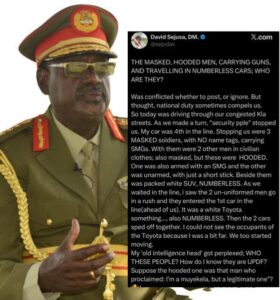
According to the account General Sejusa cited — based on eyewitness observations — motorists navigating congested Kampala streets were unexpectedly halted by individuals described as masked and heavily armed.
Three of these men were clad in what appeared to be military-style gear, each carrying submachine guns (SMGs), while two others, wearing civilian clothing and masks with hoods covering their faces, operated alongside them.
One of the hooded men was reportedly armed with an SMG; the other carried a short stick. All were positioned near a white SUV that bore no visible number plates.

Swiftness That Raised Questions
As traffic stood still, the two un-uniformed, hooded individuals are said to have rushed toward a white Toyota — the first car in the stopped line — which also had no registration plates. After a brief engagement, both the white Toyota and the numberless SUV sped off together at considerable speed.
General Sejusa noted that the rapid movement and lack of clear identifiers left witnesses and onlookers uneasy.
“We must all ask: who were these people? If they are security operatives, how are ordinary citizens to verify that?” General Sejusa was quoted as saying.
Concern Over Anonymity and Public Trust
General Sejusa has long emphasized the importance of identifiable security operations. In past public commentaries, he has cautioned that anonymity — especially when coupled with lethal weaponry — can erode trust between the public and state institutions.
In this instance, the absence of name tags, unit markings, or identifiable license plates on vehicles has become a central point of concern. For passersby and motorists alike, the distinction between legitimate armed forces and potential impersonators can become dangerously blurred.
“Identification isn’t just procedural — it’s foundational to the rule of law,” the General reportedly underscored.
Legal and Civic Implications
Experts in legal and human rights circles have echoed the concerns, noting that the use of numberless vehicles and unidentifiable operatives complicates accountability mechanisms. Without verifiable identifiers, incidents involving potential rights violations risk leaving victims with little recourse.
While security agencies often defend certain covert practices as essential for intelligence and counter-crime efforts, civilian safety advocates insist that transparency safeguards trust without necessarily jeopardizing operational effectiveness.
A Call for Clarity
General Sejusa’s commentary resonates in a context where Kampala residents increasingly seek clarity on how and by whom public security is maintained.
“Even if they are genuine security personnel,” General Sejusa reportedly remarked, “the absence of verifiable identity leaves the public uncertain and vulnerable.”
As the debate continues, authorities may face pressure to clarify procedures and reinforce public confidence in security operations carried out in civilian areas.
Hashtags:
#UgandaToday #GeneralSejusa #PublicSafety #SecurityAccountability #Kampala #RuleOfLaw
Publisher