Uganda Today: Kyagulanyi’s NUP Comes Second After Dr. Dennis Daniel Ssemugenyi in Suing Over UPDF Amendment Act, 2025
Can Twin Petitions Halt the Weaponization of Military Power Ahead of the 2026 Elections?
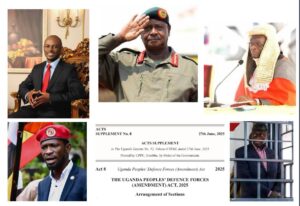
In an unusual alignment of civic and political forces, two petitions — one filed by Dr. Dennis Daniel Ssemugenyi, a public interest litigant and human rights defender, and another by the National Unity Platform (NUP) led by Robert Kyagulanyi (Bobi Wine) — have separately but decisively challenged the Uganda Peoples’ Defence Forces (Amendment) Act, 2025 at the Constitutional Court.
Though varied in scope, approach, and evidence, both petitions deliver a shared warning: that the new law poses a grave threat to civilian freedoms, judicial independence, and electoral integrity ahead of the 2026 general elections.
Dr. Ssemugenyi’s Petition: A Forensic Constitutional Assault
Filed even before the law was gazetted, Dr. Ssemugenyi’s petition invokes multiple constitutional provisions — Articles 1, 2, 20, 21, 28, 38, 40, 43, 44, 63, 126, and 137 — and asserts that any act or omission that violates the Constitution is void ab initio.
Key principles:
-
Gazettement is not required for constitutional review.
Advertising
-
Pre-enactment litigation is justified when constitutional violations are apparent on the face of a law.
-
Judicial intervention is necessary at inception to avert long-term damage.
The Petition Attacks the Act on Four Grounds:
-
Reinstatement of Military Trials for Civilians
Clauses 29 and 30 are cited as unconstitutional, violating Articles 28 and 44(c) by restoring a practice struck down in Uganda Law Society v. AG (2006) and Kabaziguruka v. AG (2021). -
Criminalization of Civilian Dress and Expression
Schedule 78 bans civilians from wearing berets, black boots, Kaunda suits, or combat gear — infringing rights to expression, equality, and lawful trade under Articles 21, 29, and 40. -
Judicial and Prosecutorial Capture by the Military
The Act creates a Military Courts Department and grants the Chief of Defence Forces (CDF) power in appointing court leaders — a direct affront to civilian judicial independence (Articles 28A, 120, 126, 128). -
Gerrymandering and Electoral Malapportionment
Using data from UBOS, Electoral Commission, and Visible Polls, he argues that electoral disparities — such as Wakiso’s 3.39 million residents with 9 MPs versus Kiboga and Ntoroko’s combined 296,215 residents with 5 MPs — violate equal suffrage and delegitimize Parliament’s authority to pass the UPDF Amendment Act.
In his rebuttal to the Attorney General, Ssemugenyi invokes Dr. Kizza Besigye’s history of military trials as a “pregnant example” of how the amended law could be used to prosecute civilians under military control, particularly when court chairpersons are under CDF command. His argument extends beyond individual cases — it warns of systemic abuse in the judicial handling of political dissent.
NUP’s Petition: Political Process and Civil Liberties
Filed after the law was gazetted, the National Unity Platform petition emphasizes procedural flaws and pre-election suppression of political freedoms.
Key highlights:
-
Procedural Irregularities
Parliament allegedly passed the 150-page Bill in under 24 hours, denying MPs time for scrutiny and violating constitutional standards of legislative process. -
Violation of Supreme Court Precedent
Reaffirms the Kabaziguruka ruling — that trying civilians in military courts is incompatible with civilian jurisprudence. -
Suppression of Civil Liberties Ahead of Elections
Describes the law as a strategic instrument to intimidate journalists, political activists, and opposition leaders. -
Permanent Injunction Sought
Requests the Constitutional Court to declare the Act unconstitutional and permanently bar military trials for civilians.
Convergence: Two Paths, One Battlefield
Though their styles differ — Ssemugenyi’s forensic and data-heavy, NUP’s urgent and political — both petitions demand:
-
Nullification of the UPDF Amendment Act.
-
Reassertion of constitutional protections for civilians.
-
Curtailment of military influence over judiciary and elections.
Key Distinction:
Dr. Ssemugenyi uniquely challenges Parliament’s legitimacy on the basis of electoral malapportionment — a bold assertion that could shake the foundation on which the Act was enacted.
What’s at Stake Before 2026
Should the Constitutional Court side with the petitioners, the ruling could:
-
Invalidate the UPDF Amendment Act entirely or in part.
-
Reinforce the Supreme Court position that military courts lack jurisdiction over civilians.
-
Trigger electoral boundary reforms, enhancing democratic fairness.
If the petitions fail:
-
Military trials of civilians may continue unabated.
-
Uganda’s judiciary risks deeper erosion of independence.
-
Elections may proceed under a cloud of militarization and inequity.
Can They Win?
Both cases are grounded in compelling constitutional arguments. The question is whether the judiciary will prioritize legal substance over procedural rigidity — and whether it will act decisively to preserve the civilian character of Uganda’s democracy.
Dr. Ssemugenyi offers constitutional depth; NUP brings political clarity. Together, their petitions may represent Uganda’s last best chance to halt the legal machinery of authoritarianism.
As 2026 looms, the Constitutional Court must now judge not just a piece of legislation — but the trajectory of the nation’s democracy.
Publisher