Uganda Today: Kakwenza Cites Constitutional Grounds to Oppose Nomination of Gen. Moses Ali
By Uganda Today Reporter
Published: June 19, 2025
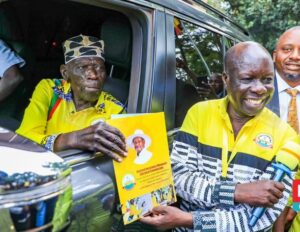
Exiled Ugandan novelist and human rights critic Kakwenza Rukirabashaija has launched a scathing legal and moral critique of the continued nomination of visibly incapacitated individuals for elective office, with his latest spotlight turned on Gen. Moses Ali, a veteran National Resistance Movement (NRM) figure and long-serving legislator.
Taking to social media, Kakwenza argued that Gen. Ali, whose frail public appearances have raised concern, ought to be disqualified from nomination for Parliament on legal and constitutional grounds.
Sovereignty and Representation
Quoting Article 1 of the 1995 Constitution, Kakwenza emphasized that “power belongs to the people and is exercised through their elected representatives.” He warned that allowing incapacitated individuals to occupy parliamentary seats amounts to disenfranchisement, as such individuals cannot meaningfully represent the electorate’s interests.

“If a representative or aspiring representative is non-functional,” Kakwenza wrote, “then the people are effectively denied representation, which violates the spirit of democratic governance.”
Mental Capacity as a Constitutional Requirement
Kakwenza further invoked Article 80(2)(f) of the Constitution, which explicitly bars persons “of unsound mind” from qualifying as Members of Parliament. He argued that this clause should automatically disqualify nominees who lack the mental and physical capacity to function effectively in Parliament.
Under the Parliamentary Elections Act, 2005 (as amended), Sections 4 and 12 reinforce this constitutional requirement. Section 12 mandates that nomination must be refused if a candidate fails to meet the qualifications outlined in Article 80, meaning the Electoral Commission must act on visible incapacity.
Upholding the Dignity of Public Office
Kakwenza broadened his critique beyond Gen. Ali, citing Section 4(1) of the Leadership Code Act, 2002 (revised 2020), which requires that public leaders conduct themselves in ways that uphold the dignity of the offices they occupy.
He described the nomination and continued stay in office of “visibly incapacitated or non-functional officials” as a mockery of leadership, going so far as to accuse Speaker Anita Among and others of violating the “spirit and standard of public service.”
Retirement on Medical Grounds
Lastly, Kakwenza cited Regulation 9 of the Public Service Regulations, 2009, which allows for retirement on medical grounds. He noted that if such provisions apply to civil servants, then a similar principle should apply to politicians whose health conditions no longer permit them to carry out their constitutional responsibilities.
Implications for the 2026 Electoral Cycle
Kakwenza’s commentary raises renewed questions for the Electoral Commission (EC) ahead of the 2026 general elections. As public concern grows over the suitability of certain candidates, calls for strict adherence to constitutional and legal standards are likely to intensify.
While the EC has not yet responded to these claims, the debate touches on broader issues of electoral integrity, ethical governance, and the meaning of representation in Uganda’s democracy.
Related Media:
🔗 View Original Post on X (formerly Twitter)
Editor’s Note: The views expressed by Kakwenza Rukirabashaija, currently living in exile, are his own and form part of a broader public discourse on leadership accountability and constitutionalism in Uganda.
Published by www.ugandatoday.co.ug, your trusted source for news and analysis
Website: https://www.ugandatoday.co.ug/about-cmk
Website: https://www.ugandatoday.co.ug
WhatsApp: +256 702 239 337
X (formerly Twitter): @uganda43443 | @ugtodaynews
Email: ugandatodayedition@gmail.com
Let’s help you grow your brand and keep your audience informed. Partner with Uganda Today—
Publisher