UgandaToday: Investigating Africa’s State Killings: A Call for Justice and Memory
By Emmanuel Mihiingo Kaija
Masterly of Biblical, Theological, and Interdisciplinary Researcher and Author
A Century of Silence Broken
For more than a century, the African continent has endured unspeakable state-sanctioned violence—massacres, enforced disappearances, and systemic killings that have claimed millions of lives. Yet much of this history has been buried in archives, silenced by political expediency, or forgotten in global narratives.
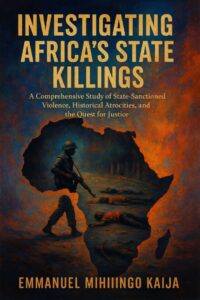
In his groundbreaking first edition of Investigating Africa’s State Killings (2025), Emmanuel Mihiingo Kaija confronts this silence head-on. Drawing from archival records, survivor testimonies, NGO reports, scholarly works, and cultural reflections, Kaija documents the machinery of impunity that continues to haunt Africa from the colonial era to the present day.
“This book,” Kaija writes, “is born out of necessity, out of a silence that has endured far too long across the continent of Africa.”
Historical Roots, Contemporary Realities
The investigation spans more than a century of atrocities:

-
Colonial brutality: King Leopold II’s Congo Free State (1885–1908) saw an estimated 10–15 million deaths from forced labor, mutilations, and famine. The Maji Maji Rebellion (1905–1907) in German East Africa claimed up to 300,000 lives.
-
Post-independence atrocities: Idi Amin’s Uganda (1971–1979) witnessed between 100,000 and 500,000 deaths, while the Nigerian Civil War (1967–1970) claimed around two million lives, mostly from starvation.
-
Genocide and civil wars: Rwanda’s 1994 genocide exterminated nearly 800,000 people in 100 days. Sudan’s Darfur massacres, Ethiopia’s Tigray conflict, and decades of bloodshed in the Democratic Republic of Congo (DRC) show that the pattern continues.
Recent years remain equally grim. Human Rights Watch recorded at least 72,000 politically motivated civilian deaths across Sub-Saharan Africa between 2015 and 2024. In 2025 alone, reports from Sudan, DRC, Rwanda, and Kenya detail hundreds of civilian massacres, abductions, and executions.
The Ethical and Moral Imperative
Kaija’s study is not just historical—it is moral. He situates Africa’s tragedies within broader ethical frameworks, drawing on African proverbs, oral traditions, and global faith teachings.
-
“The axe forgets, but the tree remembers,” reminds us of the enduring scars of violence.
-
Wole Soyinka’s observation—“When the state murders, it also murders truth”—frames the political consequences.
-
From the Bible (“Speak up for those who cannot speak for themselves”), to the Quran (“killing one innocent soul is like killing all of humanity”), to African ancestral wisdom, the call for justice is universal.
Kaija insists that silence is complicity. Survivors often refrain from speaking due to fear of reprisals—61% of victims in a 2022 Africa Human Rights Network survey admitted they remained silent. By breaking that silence, this investigation reclaims history as a tool of resistance.
Why This Investigation Matters
The book argues that documenting state killings is not merely an academic exercise—it is an act of justice, memory, and resistance.
-
For victims and survivors: their suffering is acknowledged, their stories preserved.
-
For policymakers and activists: it provides evidence for accountability and reform.
-
For African societies: it ensures future generations inherit truth, not silence.
“Every documented death, every preserved testimony, every archival record,” Kaija writes, “is an act of defiance against impunity—an insistence that African lives, past and present, matter.”
Towards Accountability and Healing
While international mechanisms such as the African Union, UN human rights bodies, and the International Criminal Court provide oversight, Kaija emphasizes their limitations. Political interference, weak enforcement, and resource constraints often leave survivors without justice.
The way forward, he argues, is independent documentation, regional accountability mechanisms, and community-driven truth-telling that bridge the gap between history and moral responsibility.
A Continental Reckoning
Investigating Africa’s State Killings is more than a chronicle of death—it is a continental reckoning. It is a reminder that Africa’s future cannot be divorced from its violent past unless memory is preserved, truth is spoken, and justice pursued.
As Kaija concludes:
“Without this work, cycles of violence continue unchecked; with it, there is hope for justice, remembrance, and the preservation of human dignity. Africa’s past and present demand nothing less.”
📖 Investigating Africa’s State Killings: A Comprehensive Study of State-Sanctioned Violence, Historical Atrocities, and the Quest for Justice — First Edition (2025) is now available for readers, scholars, and policymakers committed to truth and justice
Publisher