Uganda Today: From Muhoozi to Ruhamya: First Family’s Military Dynasty Sparks Succession Debate
By Uganda Today Newsroom
15 August 2025
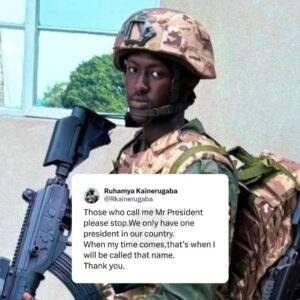
A recently circulated image of Ruhamya Kainerugaba—son to General Muhoozi Kainerugaba, Uganda’s Chief of Defence Forces—dressed in full military combat gear, has once again reignited public debate over the perceived dynastic succession plans within Uganda’s First Family.
The viral photo, originally posted by Gen. Muhoozi last month, was captioned with a declaration that his son had officially joined the military ranks. Now, a controversial statement posted on social media by Ruhamya himself has deepened public suspicion and drawn both critique and curiosity in equal measure.
“Those who call me Mr President please stop. We only have one president in our country. When my time comes, that’s when I will be called that name. Thank you,” Ruhamya posted on X (formerly Twitter), in a remark many Ugandans have interpreted as a bold affirmation of succession ambitions.
While the grooming of Gen. Muhoozi by his father, President Yoweri Museveni, has long been a subject of political analysis and speculation, Ruhamya’s emergence into the public and military limelight adds a new layer to Uganda’s evolving power dynamics. What began as covert maneuvering now appears to be an unapologetic strategy, unfolding before the eyes of the nation.

Critics have raised concerns about the consolidation of military and political power within one family, viewing it as a slow but deliberate attempt at establishing a hereditary ruling system. “What was once dismissed as hearsay is now an open secret,” remarked a Kampala-based political analyst. “We are witnessing the third tier of succession being normalized.”
The phenomenon is not unprecedented in African politics. However, the visible militarization of potential successors within the First Family has struck a nerve among Ugandans weary of dynastic entrenchment and deteriorating democratic structures.
Meanwhile, supporters of Gen. Muhoozi and his son defend the developments as normal for a family deeply committed to national service. “Serving in the army does not mean one is preparing for the presidency,” said a Muhoozi loyalist. “These are patriotic young men answering the call of duty.”
Nevertheless, Ruhamya’s words—“wait for my time”—have become a rallying point for discourse about Uganda’s political future, particularly as the country heads toward another election season under the long-serving leadership of President Museveni.
Whether the statement was youthful bravado or a carefully planted message, the implications are unmistakable. Uganda’s political chessboard is being rearranged—this time not in the shadows, but in plain sight.
Publisher