
Beyond Sameness: Understanding the Difference Between Equality, Equity, and Justice
+256 702 239 337: In many developing countries, including Uganda, equality-based policies can unintentionally reinforce existing inequalities when they fail to consider the differing needs of communities.

UgandaToday: Beyond Sameness: Understanding the Difference Between Equality, Equity, and Justice
In public policy debates, social development discussions, and governance reforms, three concepts frequently emerge: equality, equity, and justice. While these terms are often used interchangeably in everyday conversation, they represent fundamentally different approaches to addressing inequality in society.
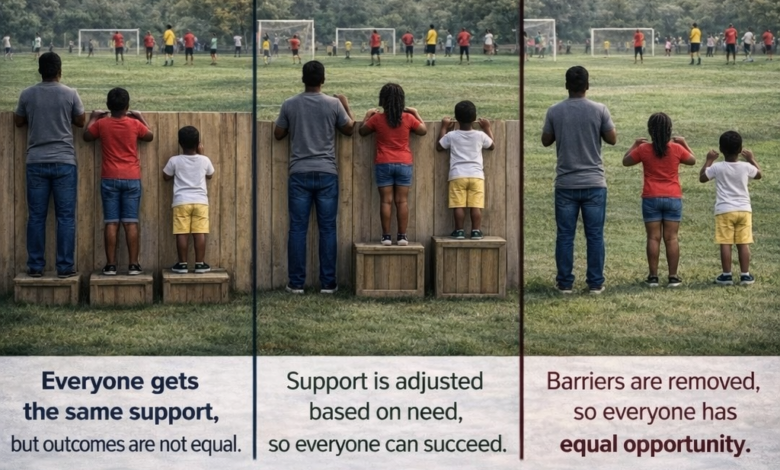
A widely shared illustration depicts three individuals attempting to watch a football match from behind a wooden fence. The three scenarios—Equality, Equity, and Justice—offer a powerful metaphor for how societies design systems that either perpetuate disadvantage or dismantle it.
For policymakers, development practitioners, and citizens alike, understanding the distinction between these concepts is crucial in shaping fair and inclusive societies.
Equality: When Everyone Receives the Same Treatment
Equality represents the idea that everyone should receive identical resources, opportunities, or treatment, regardless of their starting position.
In the illustration, three individuals of different heights are each given the same wooden box to stand on so they can look over a fence and watch the football game.
At first glance, this approach appears fair. Everyone receives the same support.
However, the outcome reveals a limitation.
The tallest person sees the match clearly. The medium-height person can see partially. The shortest person still struggles to see anything at all.
Equality assumes that everyone begins from the same starting point, which is rarely the case in real societies. Historical disadvantages, economic disparities, and structural barriers mean that identical support often produces unequal results.
In many developing countries, including Uganda, equality-based policies can unintentionally reinforce existing inequalities when they fail to consider the differing needs of communities.
Equity: Support Adjusted to Individual Needs
Equity recognizes that individuals and communities do not begin from the same starting line. Instead of distributing identical support, equity adjusts resources based on specific needs.
In the second scenario, the individuals receive different numbers of boxes depending on their height. The shortest person receives more support, while the tallest receives less.
The result is transformative: all three individuals can now see the football match clearly.
Equity therefore focuses on fairness of outcomes rather than sameness of input. It acknowledges that achieving real opportunity requires targeted interventions.
Examples of equity-based approaches include:
-
Scholarships for students from disadvantaged backgrounds
-
Rural infrastructure investments where services are lacking
-
Affirmative policies aimed at marginalized groups
Equity policies aim to level the playing field by recognizing and compensating for systemic disadvantages.
Justice: Removing the Barriers Altogether
While equity improves outcomes, justice goes a step further by addressing the root causes of inequality.
In the third scenario, the fence itself is removed. With the barrier gone, everyone can watch the football match without needing boxes.
Justice therefore focuses not merely on distributing support but on transforming the systems and structures that create inequality in the first place.
In governance and policy terms, justice may involve:
-
Reforming discriminatory laws
-
Improving access to public services
-
Eliminating systemic corruption
-
Redesigning institutions to serve all citizens fairly
Justice asks a deeper question: Why does the barrier exist at all?
By removing structural obstacles, justice ensures that equal opportunity becomes a natural outcome rather than a temporary intervention.
Why the Distinction Matters in Public Policy
For governments, development partners, and civil society organizations, confusing equality with equity—or ignoring justice altogether—can lead to ineffective policies.
A program that distributes identical resources to every district may appear fair but could fail to address the deeper disparities between urban and rural communities.
Similarly, equity interventions can provide temporary relief, but without structural reform, systemic inequalities may persist.
Effective governance therefore requires a three-dimensional approach:
-
Equality ensures fairness in basic rights and laws.
-
Equity addresses disparities in opportunity and access.
-
Justice transforms the structures that produce inequality.
A Lesson for Inclusive Development
As countries pursue economic growth and social progress, the challenge lies not only in expanding opportunities but also in ensuring that those opportunities are accessible to all citizens.
The metaphor of the fence reminds us that inequality is rarely accidental. It is often the result of systems, policies, and historical conditions that advantage some while disadvantaging others.
True progress requires more than distributing identical resources. It demands thoughtful policies that recognize different needs and, ultimately, the courage to dismantle the barriers that prevent equal participation in society.
Only then can equality, equity, and justice work together to build a truly inclusive future.
#UgandaToday #SocialJustice #EquityMatters #InclusiveDevelopment #PhoenixNewsFeeds
#OperaNewsFeeds